

Fractional CFO: When a Startup or SME Needs One
Discover when a startup or SME needs a fractional CFO, what they do, which problems they solve, and when it makes sense compared to a full-time CFO.

Many startups and SMEs reach a point where financial management can no longer be handled solely with an accountant, internal administration, and Excel spreadsheets. Growth brings complexity: more clients, higher costs, more people, larger investments, and more decisions to make. The questions the company must answer with clear data increase:
- How much cash do we really have?
- How much can we invest over the coming months?
- Which products or clients generate margin?
- When will we reach break-even?
- Are we ready to apply for financing or launch a funding round?
- Do we have a reliable management control system in place?
- Which KPIs do we need to track every month?
At this stage, senior financial expertise may be required, but hiring a full-time CFO right away does not always make sense. A fractional CFO addresses this exact need: bringing experienced financial leadership into the business, with flexible involvement proportionate to the growth phase.
What is a fractional CFO?
A fractional CFO is a senior finance director who works with the company for a fraction of the time compared to a full-time role. They can be involved a few days a month, one or more days a week, or for a specific project: fundraising, management control, financial reorganisation, reporting, budgeting, business plans, or liquidity management. Their role is not just to "crunch the numbers". A fractional CFO helps the company turn numbers into strategic decisions. They can support CEOs and founders on areas such as:
- Financial strategy;
- Management control;
- Budgeting and forecasting;
- Cash flow management;
- Margin analysis;
- Fundraising;
- Relations with banks and investors;
- Structuring KPIs;
- Executive reporting;
- Growth planning;
- Financial risk management.
In short, it is a professional who brings method, vision, and financial discipline without necessarily requiring a full-time hire.
What does a fractional CFO do?
A fractional CFO can intervene in both strategic and operational activities.
1. Establishes management control
Many SMEs know their revenue, but they do not always have clear visibility over margins, costs, or profitability per client, product, channel, or business unit. A fractional CFO helps build a management control system that allows leadership to understand where the company makes money, where it loses efficiency, and which decisions improve profitability. They can introduce:
- Management profit and loss statements;
- Cost-centre analysis;
- Margins by product or service;
- Financial dashboards;
- Economic KPIs;
- Monthly reporting;
- Variance analysis between budget and actuals.
This enables leadership to make decisions based on data, rather than just assumptions.
2. Manages cash flow and liquidity
For a startup or SME, liquidity is often more critical than short-term profitability. A company can be profitable on paper, but find itself in difficulty if client collections are delayed, suppliers are paid too quickly, or investments and working capital are not properly planned. A fractional CFO helps monitor and forecast cash flow. They can develop:
- 13-week cash forecasts;
- 6- to 12-month financial plans;
- Cash-in and cash-out analyses;
- Working capital management;
- Liquidity scenarios;
- Alert systems for potential cash crunches.
The result is a stronger capability to anticipate problems rather than merely reacting to them.
3. Builds budgets and forecasts
Growing without a budget is like driving a business by looking only in the rear-view mirror. A fractional CFO helps build a realistic budget and an up-to-date forecasting system. This makes it possible to answer vital questions:
- What revenue can we expect?
- Which costs will increase?
- How much can we invest in marketing, talent, or technology?
- Which scenarios do we need to consider?
- What happens if sales slow down?
- When will new financing be required?
For startups and SMEs, a solid forecast is not a theoretical exercise. It is a decision-making tool.
4. Supports fundraising and investor relations
For a startup, a fractional CFO can be decisive when preparing for an investment round. They can help build:
- Business plans;
- Financial models;
- Investor pitch decks;
- SaaS or startup metrics;
- Cash runway projections;
- Cap tables;
- Growth scenarios;
- Financial due diligence materials;
- Investor reporting.
Founders often know their product, market, and vision inside out, but they need a senior figure to make the financial side robust and credible. A fractional CFO helps present coherent numbers, verifiable assumptions, and a sound financial plan.
5. Improves executive reporting and dashboards
Many companies have data, but lack truly actionable information. A fractional CFO helps select a small set of relevant KPIs and make them clear and actionable for leadership. Example KPIs include:
- Recurring revenue;
- Gross margin;
- EBITDA;
- Cash burn;
- Runway;
- Customer Acquisition Cost (CAC);
- Customer Lifetime Value (LTV);
- Days Sales Outstanding (DSO);
- Profitability per client;
- Growth rate;
- Budget vs actual variance.
The goal is not to flood the company with reports, but to create a dashboard that empowers CEOs, founders, and management to make better decisions.
6. Acts as a strategic sounding board for CEOs, founders, and leadership
A fractional CFO does not just work with numbers. They work directly alongside executive leadership. They can help the business owner or founder evaluate:
- New hires;
- Capital expenditure;
- Pricing strategies;
- Partnerships;
- Market expansions;
- Acquisitions;
- Cost reduction initiatives;
- Growth sustainability;
- Capital structure;
- Risk-return trade-offs.
In many SMEs, the CEO makes major financial decisions without a truly senior internal peer to consult. A fractional CFO brings that sounding board, with methodical rigour and objective independence.
When a startup needs a fractional CFO
A startup can benefit immensely from a fractional CFO once it moves beyond the initial stage and needs to manage growth, capital, metrics, and investors in a more structured manner.
1. Ahead of an investment round
If a startup aims to raise capital, it must present rock-solid numbers. A fractional CFO can help prepare the financial model, cash plan, metrics, scenarios, cap table, and investor documentation. Their role is to make the startup more credible and fully prepared for due diligence.
2. When burn rate is out of control
Many startups scale quickly but lack clear visibility into their burn rate, runway, and cost sustainability. A fractional CFO helps answer questions such as:
- How many months of cash do we have left?
- What happens if the funding round is delayed?
- Which expenses can we reduce without stifling growth?
- Which investments are genuine priorities?
- What level of growth is sustainable?
3. When the founder is still handling all the finances
In the early stages, it is normal for the founder to handle budgets, payments, metrics, and investor updates. However, this eventually turns into a critical operational bottleneck. A fractional CFO frees up the founder's time while raising the quality of financial decision-making.
4. When more mature metrics are needed
To scale sustainably, a startup must monitor the right metrics. Depending on the business model, these might include: MRR, ARR, CAC, payback period, gross margin, burn multiple, runway, net revenue retention, and segment margins. A fractional CFO helps define which metrics truly matter and how to leverage them to steer growth.
5. When new investors come on board
Following an investment round, expectations around governance, reporting, and transparency increase significantly. A fractional CFO can establish an investor reporting system, regular updates, KPI monitoring, and expectations management.
When an SME needs a fractional CFO
For an SME, a fractional CFO is valuable when financial management becomes too complex to be handled solely by administrative staff and external tax accountants.
1. When the business is growing, but margins are unclear
An SME can increase revenue while simultaneously seeing its profitability decline. This happens when there is a lack of clear visibility into:
- Indirect overheads;
- Margin by client;
- Margin by product line;
- Commercial discounts;
- Production costs;
- Operational efficiency;
- Collection times;
- Outdated pricing.
A fractional CFO helps identify where real business value is actually generated.
2. When structured management control is lacking
Many SMEs maintain accurate accounting records, but lack the management control insights required by executive leadership. Financial accounting primarily looks back at the past. Management control exists to shape the future. A fractional CFO builds tools to track performance, variances, margins, and the ongoing viability of commercial decisions.
3. When stronger relationships with banks or lenders are required
An SME may need capital to finance investments, business expansion, internationalisation, acquisitions, or working capital. A fractional CFO can support:
- Financial plans;
- Bankable business plans;
- Funding requirements analysis;
- Preparation of credit files and documentation;
- Negotiations with lenders;
- Monitoring debt covenants and financial commitments.
4. When the business owner wants to make data-driven decisions
In many SMEs, decisions are still made based on gut feeling, experience, and direct intuition. While invaluable, these qualities are not sufficient once a business reaches a certain scale. A fractional CFO helps the business owner combine intuition with rigorous data, strengthening decisions around investments, pricing, staffing, suppliers, and markets.
5. When the business is preparing for a major transition
A fractional CFO can prove essential during key transitional phases, such as:
- Generational succession;
- Onboarding new partners or equity investors;
- Acquiring another company;
- Selling the business;
- Opening a new office or facility;
- Launching a new business unit;
- Financial restructuring;
- Liquidity crunches;
- Turnaround plans.
In these moments, the calibre of financial leadership can make all the difference.
Signs that indicate you need a fractional CFO
A startup or SME should consider a fractional CFO when signals like these arise:
- Revenue is growing, but cash remains under constant pressure;
- Profit margins are unclear;
- The CEO lacks reliable management reports;
- The budget is drafted once a year and immediately forgotten;
- Financial decisions rely on outdated Excel sheets;
- The external accountant is the only person providing figures;
- Investors are demanding more structured reporting;
- Banks are asking for more solid financial projections;
- The administration team is operational, but lacks strategic vision;
- The company is unsure how much it can afford to invest;
- Costs are growing faster than revenue;
- The founder spends too much time on finance and administration;
- There is no credible forecast for the next 6-12 months.
These signs do not necessarily mean you need to hire a full-time CFO immediately. They often indicate you need senior guidance on a flexible, part-time basis.
Fractional CFO vs full-time CFO: How to decide
The choice depends on the company's stage of development, complexity, budget, and the continuity of the need. Generally, a fractional CFO is ideal when the financial need is strategic and significant, but does not yet justify a full-time executive salary. A full-time CFO becomes the better option when the business faces continuous complexity, manages a large finance team, executes frequent corporate transactions, or operates with a mature corporate governance structure.
Fractional CFO, accountant, and head of administration: What are the differences?
One of the most frequent questions is: "If we already have an external accountant and an in-house administration manager, why would we need a fractional CFO?" The answer is that these roles serve fundamentally different purposes.
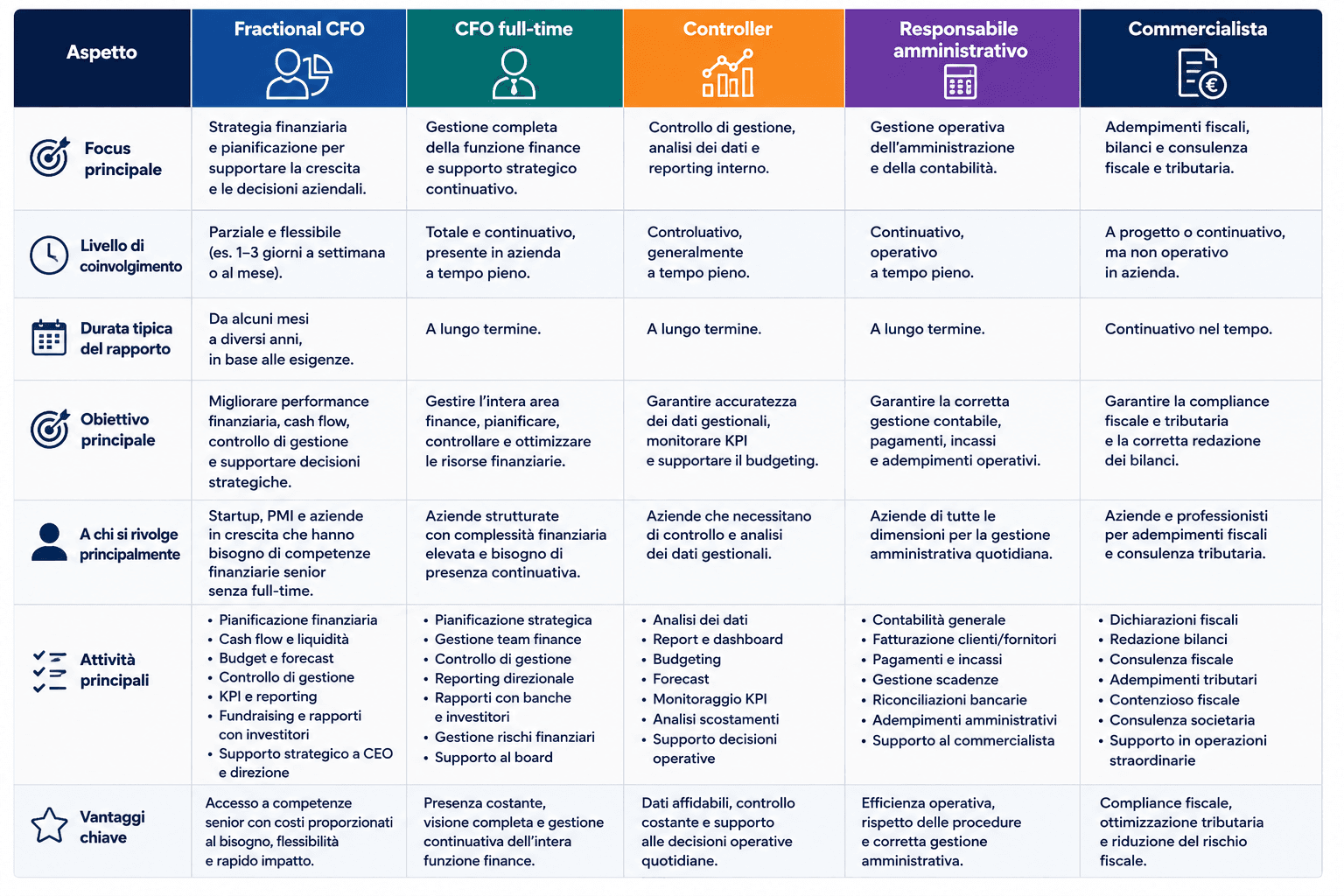
A fractional CFO does not replace these professionals. Instead, they coordinate, align, and elevate their work, transforming routine administrative and bookkeeping data into actionable insights for leadership.
What a fractional CFO can deliver in the first 30, 60, and 90 days
First 30 days: Diagnosis and priorities
During the first month, the fractional CFO can:
- Review financial statements, cash flow, and management accounts;
- Assess the quality and accuracy of available data;
- Identify critical issues across margins, cash flow, and overheads;
- Map existing reporting workflows;
- Align with the CEO, administration team, accountant, and investors;
- Define key financial priorities;
- Build an initial roadmap.
Expected deliverables:
- Financial diagnostic report;
- Prioritised action list;
- Initial core KPIs;
- Action roadmap;
- Clear visibility on immediate financial risks.
Within 60 days: Tools and quick wins
By the second month, the fractional CFO can:
- Set up a rolling cash forecast;
- Build an executive dashboard;
- Refine budgeting and reporting routines;
- Conduct in-depth margin analysis;
- Review cost structures and capital allocation;
- Prepare documentation for banks or investors;
- Introduce a regular financial review process.
Expected deliverables:
- Greater control over liquidity;
- Clear, readable executive reports;
- Faster decision-making cycles;
- Initial corrective actions on costs, pricing, or margins;
- Leadership team fully aligned on financial metrics.
Within 90 days: Consolidation and strategic roadmap
By the third month, the fractional CFO can:
- Standardise the monthly financial reporting cycle;
- Consolidate budgets and rolling forecasts;
- Model dynamic financial scenarios;
- Transfer financial management processes to the internal team;
- Structure regular investor updates;
- Support funding negotiations;
- Define a 6- to 12-month strategic financial plan.
Expected deliverables:
- A robust, scalable finance function;
- Consistently tracked KPIs;
- Greater operational autonomy for the internal team;
- Clear long-term financial trajectory;
- Informed decision-making on future steps.
Practical example for a startup
A B2B SaaS startup has been operating for 18 months, generating recurring revenue with a lean team, and aims to raise a Seed round. The founder is still managing the financial model, cash position, and reports for prospective investors. The core challenges are:
- The financial model is outdated;
- SaaS metrics are not tracked accurately;
- The burn rate is increasing;
- The pitch deck fails to present a convincing case for business viability;
- Runway projections are ambiguous;
- Investors are requesting more institutional data.
A fractional CFO can step in to:
- Overhaul the financial model;
- Accurately calculate MRR, ARR, churn, CAC, LTV, and runway;
- Model growth scenarios;
- Set up professional investor reporting;
- Strengthen the fundraising plan;
- Support the due diligence process.
In this context, the fractional CFO is not an administrative cost; they serve as a strategic lever that elevates the startup's credibility in the capital markets.
Practical example for an SME
A manufacturing SME sees revenue grow by 20%, but the business owner notices that cash flow remains under constant strain. The company relies on an external accountant and an in-house administration team, but lacks advanced management control. The problems include:
- Unclear margins across product lines;
- Outdated price lists;
- Lengthy collection terms;
- Escalating indirect costs;
- No rolling cash forecast;
- Investment decisions made without scenario planning.
A fractional CFO can step in to:
- Analyse margins by product and client profile;
- Implement a rolling cash forecast;
- Review pricing models and discount policies;
- Design monthly executive reporting dashboards;
- Identify and manage critical cost drivers;
- Strengthen banking relationships;
- Draft a sustainable financial plan for growth.
Here, the fractional CFO helps the business owner transform expansion from simply "more turnover" into "more enterprise value".
When you do not need a fractional CFO
A fractional CFO is not always necessary. It may not be the right choice if:
- The business is very small and only requires basic bookkeeping;
- There are no major strategic or financial decisions to make;
- The requirement is strictly tax-related;
- Leadership is unwilling to share sensitive business data;
- There is no openness to restructuring internal processes;
- The business needs a full-time, day-to-day operational manager;
- The company simply needs standard bookkeeping support.
A fractional CFO delivers impact when there is a real need for senior strategic guidance, not merely administrative execution.
How to choose the right fractional CFO
When selecting a fractional CFO, it is crucial to assess:
- Track record with companies of similar scale and growth stage;
- Relevant industry experience;
- Expertise across startups, SMEs, fundraising, or corporate finance;
- Ability to communicate effectively with business owners, founders, banks, and investors;
- Proven expertise in management control;
- Pragmatic, action-oriented mindset;
- Capacity to establish simple, workable systems;
- Availability tailored to the company's requirements;
- Ability to collaborate with internal administrative staff and external advisors.
An effective fractional CFO should not just understand finance; they must know how to translate financial insights into sound commercial decisions.
How to prepare for the arrival of a fractional CFO
To capture value quickly, companies should gather key documentation before the engagement begins:
- Recent statutory financial statements;
- Up-to-date management accounts;
- Revenue and margin data;
- Current cash position;
- Client breakdown and revenue breakdown;
- Major overheads and expenditure overview;
- CapEx plan;
- Outstanding debts or credit facilities;
- Existing reports and dashboards;
- Current budgets or forecasts;
- Cap table (for startups);
- Investor decks and materials, if available.
You do not need everything to be immaculate. In fact, a fractional CFO is often engaged precisely because existing figures are disorganised. However, starting with available documentation helps accelerate the initial phase.
How Workbloom can help
Workbloom helps startups, SMEs, and scaling companies quickly connect with senior consultants, on-demand executives, and fractional managers tailored to their specific needs. When hiring a fractional CFO, Workbloom supports businesses requiring senior financial leadership in areas such as:
- Management control;
- Cash flow management;
- Budgeting;
- Financial planning;
- Fundraising;
- Investor reporting;
- Banking relationships;
- Margin analysis;
- Financially sustainable growth;
- Restructuring the finance function.
Thanks to BlooMIA, Workbloom's AI-driven matching engine, businesses can identify the right professional based on industry, growth phase, project complexity, and strategic goals. This streamlines the hiring process and ensures you find an on-demand CFO whose experience directly aligns with your operational priorities.
Fractional CFO FAQs
What is a fractional CFO?
A fractional CFO is a senior finance director who supports a company on a part-time or flexible basis, without being hired full-time. They guide financial strategy, management control, cash flow, budgeting, forecasting, and fundraising.
When do you need a fractional CFO?
You need one when your startup or SME requires senior financial expertise without the overhead of a full-time CFO. Common triggers include rapid growth, fundraising, cash flow pressures, lack of management control, or the need for more structured executive reporting.
How much does a fractional CFO cost?
The cost depends on seniority, scope of involvement, duration, complexity, and project objectives. Overall, the fractional model enables businesses to access high-level expertise with an investment proportionate to their specific needs.
What is the difference between a CFO and an accountant?
An accountant focuses on tax compliance, financial accounts, and statutory requirements. A CFO focuses on strategic financial management: forward planning, cash flow, management control, KPIs, capital investments, funding, and commercial decisions.
Can a fractional CFO help a startup raise capital?
Yes. They can build financial models, business plans, metrics, investor decks, and cap tables, as well as handle investor reporting and due diligence preparation.
Does a fractional CFO replace the head of administration?
Not typically. Instead, they work alongside and coordinate the administrative function, turning bookkeeping data into strategic insights for company leadership.
Is a fractional CFO or a full-time CFO better?
It depends on the company's stage. A fractional CFO is ideal when senior expertise is needed without a full-time commitment. A full-time CFO is more appropriate when financial complexity is structural and continuous.
Conclusion
A fractional CFO is a practical solution for startups and SMEs looking to scale with greater control, without committing immediately to a full-time executive hire. They can help manage liquidity, budgets, forecasts, margins, fundraising, reporting, and strategic decisions. For a startup, it means presenting a stronger case to investors while controlling burn rate and runway. For an SME, it means gaining true visibility over margins, cash flow, and the sustainability of growth. In both cases, the value goes beyond tidier accounts: it empowers leadership to make better business decisions.
Do you need senior financial leadership for a specific phase of your business? With Workbloom, you can find the right fractional CFO for your goals and transform numbers into concrete decisions. (https://workbloom.io/bloomers)
Book a call with Workbloom and find out how to activate the right expertise for your business. (https://calendly.com/erika-00-ea/15-minute-meeting-woorkbloom)
Find out what on-demand consulting is (https://workbloom.io/blog/consulenza-on-demand-per-pmi-cos%C3%A8-come-funziona-e-quando-conviene-davvero) Find out who a Fractional Manager is and when you need one (https://workbloom.io/blog/fractional-manager-chi-%C3%A8-cosa-fa-e-quando-serve) Find out what an on-demand manager can deliver in 90 days (https://workbloom.io/blog/manager-on-demand-cosa-pu%C3%B2-fare-in-30-60-e-90-giorni-per-una-pmi)