

On-demand manager: what they can do in 30, 60, and 90 days for an SME
Discover what an on-demand manager can do for an SME in the first 30, 60, and 90 days: objectives, activities, expected outcomes, and concrete use cases.

Many SMEs reach a point where growth slows, processes become more complex, or decisions require skills that are not yet present in-house. You might need senior guidance to structure sales, improve management control, digitise processes, introduce AI, reorganise the team, or launch in a new market. The problem is that hiring a full-time manager straight away does not always make sense. Recruitment timelines can be lengthy, costs high, and the need may only be tied to a specific phase. In these cases, an on-demand manager can help an SME gain rapid access to senior managerial expertise, through flexible engagement focused on concrete objectives. But what can an on-demand manager really accomplish in the first 30, 60, and 90 days?
What is an on-demand manager
An on-demand manager is a senior professional who joins a business to support a specific function, project, or phase without being hired full-time. They can operate as a:
- fractional manager;
- interim manager;
- senior operational consultant;
- project manager;
- advisor with executive responsibilities.
Their primary characteristic is flexibility: the company deploys the right expertise when needed, for as long as required, and under a clearly defined brief. Unlike purely strategic consultants, on-demand managers work closely alongside the internal team. Rather than stopping at recommendations, they help translate decisions into actions, processes, priorities, and measurable results.
Why the on-demand model works well for SMEs
For an SME, bringing in senior managerial expertise can be challenging. Often the business needs experienced profiles, but:
- lacks the budget for a full-time C-level hire;
- cannot afford a lengthy recruitment process;
- is unsure which exact profile to hire;
- faces an urgent issue that needs resolving;
- must navigate a temporary period of change;
- wants to validate a new direction before building out an internal team.
The on-demand manager addresses precisely this need: injecting managerial experience where it is needed, when it is needed, without weighing down the company structure.
What an on-demand manager can do in the first 30 days
The first 30 days are primarily dedicated to diagnosis, prioritisation, and building an action plan. The goal is not to change everything immediately, but to quickly understand where to intervene to generate real impact.
1. Analysing the business situation
The on-demand manager starts with a practical reading of the context. They may analyse:
- the business model;
- internal organisation;
- decision-making processes;
- financial and sales figures;
- sales pipeline;
- marketing structure;
- digital tools;
- team skills;
- operational bottlenecks;
- leadership objectives.
This phase serves to separate symptoms from root causes. For instance, an SME might believe it has a sales problem, only to discover that the real issue stems from positioning, profit margins, pipeline management, or a lack of reliable data.
2. Identifying priorities
An SME cannot afford to spread its energies across too many fronts. Therefore, in the first 30 days, the on-demand manager helps answer a fundamental question: what are the 2 or 3 priorities that can generate the greatest impact over the coming months? Priorities may involve:
- increasing qualified leads;
- improving sales conversion rates;
- reducing operational inefficiencies;
- introducing a management control system;
- selecting new software;
- reviewing roles and responsibilities;
- preparing a growth plan;
- improving cash flow and margins;
- launching a realistic AI initiative.
The value of an on-demand manager lies not just in "doing", but in deciding what to do first.
3. Defining measurable objectives
An on-demand intervention works when there is complete clarity on what it must deliver. Defining KPIs and expected outcomes is therefore essential in the first 30 days. Examples include:
- increasing the number of qualified leads by 20%;
- shortening sales closing cycles;
- building a 12-month financial forecast;
- defining a digital roadmap;
- reducing repetitive manual tasks;
- improving margins on specific product lines;
- introducing a monthly reporting framework;
- redesigning the HR onboarding process.
Objectives must be realistic, yet clear enough to steer subsequent work.
4. Building an operational roadmap
By the end of the first month, the on-demand manager should deliver a simple, concrete roadmap. Not a theoretical document, but an operational plan detailing:
- priorities;
- activities;
- internal owners;
- timelines;
- risks;
- dependencies;
- quick wins;
- KPIs;
- review milestones.
This roadmap becomes the operational foundation for the subsequent 60 days.
Expected outcomes in the first 30 days
After the first month, an SME should have:
- greater clarity on underlying issues;
- defined priorities;
- measurable objectives;
- a shared action plan;
- initial high-impact actions underway;
- alignment between leadership and the team.
In short: within the first 30 days, the on-demand manager brings order, focus, and methodology.
What an on-demand manager can achieve within 60 days
Between days 30 and 60, the focus shifts from diagnosis to execution. The goal is to start implementing priority actions, engage the team, and generate early, tangible results.
1. Launching early operational interventions
Depending on their area of expertise, the on-demand manager can begin tackling highly practical tasks. For a Sales & Marketing manager:
- refines commercial positioning;
- structures the funnel;
- improves lead qualification;
- defines scripts, processes, and metrics;
- aligns marketing and sales;
- introduces more effective sales meetings.
For a fractional CFO:
- sets up cash flow management and forecasting;
- reviews margins and cost structures;
- builds financial dashboards;
- prepares reporting for management or investors;
- strengthens management control.
For a fractional CTO or IT manager:
- evaluates systems and vendors;
- identifies digital inefficiencies;
- defines the technology roadmap;
- supports tooling selection;
- establishes governance for digital projects.
For an on-demand HR manager:
- clarifies roles and responsibilities;
- improves onboarding and performance management;
- supports critical recruitment drives;
- helps manage organisational change;
- structures core HR processes.
2. Engaging the internal team
A good on-demand manager does not work in isolation. Their role also involves upskilling the internal team, introducing methodology, and building decision-making capabilities. Within the first 60 days, they can:
- clarify decision-making ownership;
- assign responsibilities;
- establish structured work routines;
- improve cross-functional communication;
- create shared dashboards;
- coach key personnel;
- reduce reliance on the business owner or founder.
This is especially crucial in SMEs, where many decisions remain bottlenecked around a few individuals.
3. Delivering measurable quick wins
Within 60 days, it is realistic to expect initial concrete results. These will not always be definitive financial outcomes, but they serve as critical indicators of progress. Examples of quick wins include:
- a more organised sales pipeline;
- a clear, readable financial forecast;
- a dashboard tracking core KPIs;
- clearer internal workflows;
- a reduction in manual work;
- more informed vendor selection;
- better project prioritisation;
- more targeted marketing campaigns;
- stronger alignment between management and the team.
The value of quick wins is twofold: they create immediate impact and build confidence in the process.
4. Correcting what isn't working
The initial roadmap should never be rigid. After 60 days, the on-demand manager can assess what is delivering and what is not. They can then:
- adjust priorities;
- cut redundant activities;
- iterate the plan;
- reallocate resources;
- refine KPIs;
- tackle newly uncovered bottlenecks.
This pragmatic approach is particularly valuable for SMEs and startups, where conditions change rapidly and decisions must adapt quickly.
Expected outcomes within 60 days
After two months, an SME should see:
- initial actions implemented;
- a more engaged team;
- clearer workflows;
- more actionable data;
- operational quick wins;
- improved decision-making capability;
- greater control over priorities.
In short: within 60 days, the on-demand manager turns the plan into execution.
What an on-demand manager can achieve within 90 days
The period between 60 and 90 days is when the intervention begins to take root. The objective is to turn initial initiatives into a more resilient, permanent system.
1. Consolidating processes and ownership
After 90 days, the business should not depend solely on the on-demand manager's presence. The work must start becoming part of the company's internal capabilities. To achieve this, the manager can:
- document processes;
- define roles and responsibilities;
- establish control routines;
- set up recurring review meetings;
- transfer knowledge;
- train internal team leads;
- make new practices repeatable.
This is one of the most critical steps: an on-demand manager should not create dependency, but rather increase the company's ability to manage its own priorities.
2. Measuring results
By day 90, the initial impact of the engagement can be formally measured. Outcomes will vary widely depending on the objective, but they should be quantifiable. Examples include:
- higher sales pipeline quality;
- improved visibility into cash flow and margins;
- reduced operational inefficiencies;
- faster decision-making cycles;
- stronger governance over digital initiatives;
- a clearer commercial strategy;
- greater autonomy across the team;
- recruitment or onboarding of key hires;
- validation of a new market or channel.
Not every financial result shows up within 90 days, but within 90 days it must be clear whether the business is moving in the right direction.
3. Deciding the next step
At the close of the first 90 days, the company can make a well-informed decision. Several paths are possible:
- continue working with the on-demand manager;
- scale back their involvement;
- transition the role into an ongoing fractional arrangement;
- hire a full-time internal profile;
- engage a different senior profile for the next phase;
- close the project because the objectives have been met.
This flexibility is one of the main advantages of the on-demand model: it lets you test and calibrate the level of senior expertise required without rigid long-term commitments.
4. Building a medium-term roadmap
After 90 days, the on-demand manager can help the business shape its plan for the next 6 to 12 months. They can outline:
- which skills are still missing;
- which processes need consolidation;
- which investments should be prioritised;
- which risks need managing;
- which KPIs to track continuously;
- which profiles to recruit internally;
- which initiatives can remain on-demand.
This ensures the intervention does not remain an isolated exercise, but becomes part of a robust, long-term growth trajectory.
Expected outcomes within 90 days
After three months, an SME should have:
- more structured processes;
- clearer lines of responsibility;
- monitored KPIs;
- tangible evidence of impact;
- a more autonomous team;
- more informed decision-making;
- a defined roadmap for the future.
In short: within 90 days, the on-demand manager consolidates change and guides the company on what to do next.
Practical case: on-demand manager for a commercial SME
Consider a B2B SME facing flat sales, an unstructured marketing setup, and a heavy reliance on the founder.
First 30 days
The on-demand manager analyses:
- the sales process;
- the pipeline;
- acquisition channels;
- proposals and offerings;
- market positioning;
- margins per client;
- sales team capabilities.
Deliverables:
- problem diagnosis;
- commercial priorities;
- restructured pipeline;
- core KPIs;
- action plan.
Within 60 days
The manager implements:
- a revised sales workflow;
- a new lead qualification framework;
- weekly sales review meetings;
- improved pitching scripts and follow-up sequences;
- alignment between marketing and sales;
- a commercial dashboard.
Deliverables:
- transparent sales tracking;
- a more focused team;
- less time wasted on unqualified leads;
- clearer visibility into pipeline opportunities.
Within 90 days
The manager consolidates:
- the sales methodology;
- team accountability;
- regular reporting;
- focus on higher-margin accounts;
- a sales growth roadmap.
Deliverables:
- a repeatable sales process;
- a healthier, more reliable pipeline;
- clearer strategic direction for leadership;
- a well-grounded decision on hiring an in-house sales manager or engaging a fractional CMO.
Practical case: on-demand manager for digital transformation
An SME aims to digitise operations but does not know where to start. It relies on disparate software, endless spreadsheets, manual workarounds, and uncoordinated external suppliers.
First 30 days
The on-demand manager:
- maps existing tools and processes;
- identifies workflow bottlenecks;
- reviews costs and operational risks;
- assesses internal digital skills;
- defines digital transformation priorities.
Deliverables:
- digital maturity assessment;
- operational inefficiency audit;
- prioritisation matrix based on impact and complexity;
- initial transformation roadmap.
Within 60 days
The manager:
- selects tools and vendor partners;
- sets up project governance;
- eliminates recurring manual steps;
- defines internal system owners;
- launches an initial pilot project.
Deliverables:
- digital pilot successfully launched;
- clear project ownership;
- reduced operational confusion;
- more informed technology procurement.
Within 90 days
The manager:
- evaluates early metrics and results;
- documents systems and workflows;
- transfers technical knowledge to the team;
- plans future tech investments;
- assesses future talent requirements.
Deliverables:
- a structured digital transition;
- reduced tool redundancy and waste;
- a realistic 6- to 12-month tech roadmap;
- effective control over technology vendors.
On-demand manager, fractional manager, and interim manager: choosing the right fit
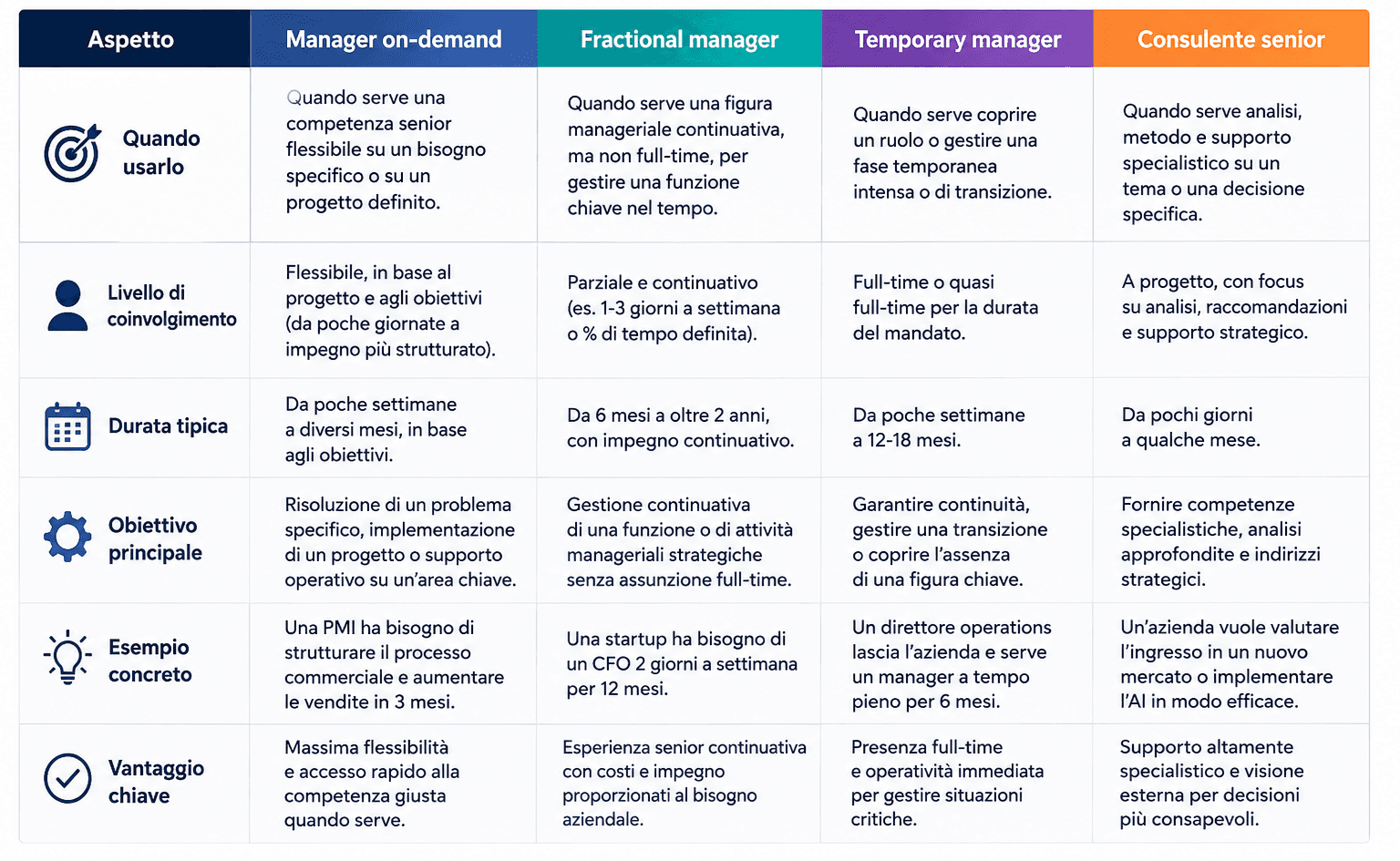
Workbloom helps organisations select the most suitable model based on their goals, urgency, project duration, and required skills.
When to bring in an on-demand manager
An on-demand manager proves valuable when an organisation encounters scenarios such as:
- unstructured or chaotic growth;
- flat or unpredictable sales cycles;
- insufficient financial oversight and control;
- challenges in making sound technology decisions;
- the need to implement AI or modern digital tools;
- the unexpected departure of a key leader;
- expansion into a new market;
- fundraising preparation;
- a young or relatively inexperienced internal team;
- the absence of senior leadership in a business-critical function.
The clearest indicator is this: the business recognises a major problem, but lacks the internal expertise to solve it systematically.
When an on-demand manager is not enough
An on-demand manager is not a silver bullet. The arrangement may fall short when:
- leadership lacks genuine commitment;
- there are no internal team members available to collaborate;
- the organisation resists adapting its processes or habits;
- the challenge demands an immediate, full-time hire;
- objectives remain vague and undefined;
- the company is merely seeking cheap operational execution.
To succeed, this model requires clarity, close collaboration, and a willingness to make decisive changes.
How to prepare for an on-demand manager's arrival
To capture value quickly, an SME should gather essential information ahead of the kickoff.
1. Define the problem
You do not need to have the solution figured out, but you must clearly define the underlying need.
2. Gather key data
Depending on the functional area, this may include: financial statements; forecasts; sales performance data; commercial pipeline; organisation chart; current processes; tooling inventory; existing KPIs; active projects; known bottlenecks.
3. Involve key stakeholders
The on-demand manager needs direct access to the people who understand the day-to-day challenges. It is therefore vital to involve: the founder or CEO; department heads; operational team members; finance; sales; HR; IT; key external partners.
4. Set realistic expectations
How Workbloom can help
Workbloom connects companies, SMEs, and startups with senior consultants, on-demand managers, and fractional leaders available for targeted projects. The platform provides access to deep vertical expertise across areas including:
- Business Strategy & Management;
- Sales & Marketing;
- AI Experts;
- IT & Digital;
- Finance;
- Legal;
- HR & Payroll;
- Operations;
- ESG Strategy;
- Safety & Risk;
- Medical Affairs;
- UX/UI.
Powered by BlooMIA (https://youtu.be/lnyHc5gvC5k), Workbloom's AI-driven matching engine, businesses can swiftly identify the most suitable professional based on objectives, industry, function, seniority, and project requirements. This cuts the time needed to source senior talent and accelerates the transition from problem to execution.
What this means for your business
For an SME, engaging an on-demand manager means avoiding the trap of two extremes: trying to handle everything in-house without the right skills, or taking on the cost and commitment of an immediate full-time hire. There is a pragmatic alternative: bringing in a senior manager for a targeted phase, with clear objectives and a level of involvement scaled to your actual needs. In 30 days, they establish clarity. In 60 days, they drive execution. In 90 days, they consolidate methodology, workflows, and decisions. The value lies not merely in having an "extra pair of hands", but in securing the right expertise exactly when it can make a decisive difference.
On-demand manager FAQs
What is an on-demand manager?
An on-demand manager is a senior professional who assists a business across a specific function, project, or phase without joining on a permanent, full-time contract.
What can an on-demand manager do in 30 days?
In the first 30 days, they analyse the operational context, identify strategic priorities, define clear KPIs, and establish an actionable roadmap.
What can an on-demand manager achieve in 60 days?
Within 60 days, they roll out initial initiatives, rally the internal team, streamline processes, and deliver measurable quick wins.
What can an on-demand manager achieve in 90 days?
Within 90 days, they embed new processes, quantify business outcomes, transfer skills to in-house teams, and establish the next phase of the roadmap.
What is the difference between an on-demand manager and a fractional manager?
On-demand manager is an umbrella term covering flexible managerial arrangements. A fractional manager is a specific type of on-demand executive who works for a fraction of their time, typically on a recurring, ongoing basis.
When is it worth hiring an on-demand manager?
It is worth doing whenever you need senior leadership to tackle growth, finance, sales, digital transformation, AI adoption, HR, operations, or organisational restructuring, without requiring a permanent full-time executive.
Does an on-demand manager replace a management consulting firm?
Not necessarily, as it depends on your requirements. Compared to conventional management consultancies, however, on-demand managers work much closer to your in-house teams and take direct operational ownership.
Conclusion
An on-demand manager helps an SME break down complex strategic challenges into an actionable, progressive, and measurable plan. For companies looking to scale, digitise, reorganise, or close a senior leadership gap, this model provides an agile, pragmatic solution. Need senior managerial expertise for a key phase in your company's growth? With Workbloom, you can match with the right on-demand manager for your goals and start turning strategy into execution. (https://workbloom.io/bloomers)
Book a call with Workbloom to discover how to deploy the right support for your business. (https://calendly.com/erika-00-ea/15-minute-meeting-woorkbloom)
Learn more about On-Demand Consulting (https://workbloom.io/blog/consulenza-on-demand-per-pmi-cos%C3%A8-come-funziona-e-quando-conviene-davvero) Learn more about what a Fractional Manager is and when you need one (https://workbloom.io/blog/fractional-manager-chi-%C3%A8-cosa-fa-e-quando-serve)